Rethinking Automotive Sales Training – Why L&D Must Evolve Faster Than the Vehicles We Sell
After two decades immersed in automotive training, one truth has become impossible to ignore. The industry is not experiencing disruption. It is experiencing continuous evolution. Vehicles have transformed. Customer expectations have transformed. Regulatory frameworks across Europe continue to shift, political uncertainty affects consumer confidence, and the pace of change shows no sign of slowing. Yet many training strategies inside OEMs have barely moved. For learning leaders, this growing gap is becoming a real risk.
Sales teams today face a level of complexity that simply did not exist ten years ago. Electrification, digital services, connectivity, over-the-air updates, advanced safety technologies, and subscription models have expanded the salesperson’s role far beyond traditional product knowledge. We are no longer teaching people how to sell cars. We are teaching them how to sell platforms, services, and digital ecosystems to very different types of customers.
If training is going to support this reality, it must be fundamentally rethought.
The Sales Role Has Changed Faster Than L&D Has
The rise of software-defined vehicles has fundamentally altered the sales conversation. Customers now ask how features are activated, which services require subscriptions, whether pricing is monthly or annual, and which connected functions genuinely add value to their individual use case.
At the same time, customers are no longer homogeneous. An EV-first adopter expects a very different conversation from a cautious first-time electric buyer. A fleet customer has different priorities than a private customer. One-size-fits-all sales approaches no longer work.
Sales teams must be able to explain complex systems clearly, adapt their language to different customer types, and build trust in moments of uncertainty. That requires depth, not surface-level familiarity.
Many OEMs underestimate how much learning this actually requires. Short bursts of micro content do not prepare someone to guide a customer through a subscription decision or to explain why certain safety systems behave differently in urban traffic versus long-distance driving. Learning leaders need to acknowledge that the product has changed, the customer has changed, and the training architecture must evolve accordingly.
Why Micro Content Can Support Learning but Cannot Replace It
I understand the appeal of YouTube-style microlearning. People enjoy it. They use it. I do too when I need a quick answer. But it is a supplement, not a strategy.
Micro content is excellent for refreshing knowledge, reinforcing concepts, or solving a specific task at the point of need. What it cannot do is build the deep understanding and adaptability required to advise customers confidently across different scenarios.
If L&D decision-makers rely on short videos to carry the full weight of sales capability development, the result is predictable: shallow competence and inconsistent customer experiences.
A modern learning ecosystem must combine formats. Structured onboarding. Instructor-led depth. Simulation-based practice. Micro reinforcements. Coaching at the point of sale. No single channel is sufficient on its own.
Turnover Makes Structured Onboarding Essential
High turnover remains one of the biggest challenges in automotive retail. In many dealerships, more than thirty percent of the salesforce changes every year. In this environment, structured onboarding is not optional. It is essential.
New hires cannot be expected to learn purely through observation or informal mentoring. They need a clear zero-to-hero pathway that introduces skills progressively and builds a solid foundation from day one.
The strongest onboarding programmes are immersive, time-protected, and supported by leadership. When onboarding fails, sales quality suffers. When onboarding succeeds, it creates confident professionals who stay longer, perform better, and represent the brand consistently.
Simulations Are the Future of Skill Development
Younger generations respond poorly to traditional role plays. Many find them artificial, uncomfortable, or disconnected from reality. Simulations address this challenge directly.
They allow learners to practice realistic scenarios in a safe environment, receive immediate feedback, and repeat exercises until confidence is built. And repetition matters. Exercise, exercise, exercise.
Simulations are particularly powerful in areas where customer conversations are complex or sensitive: subscription value discussions, EV range expectations, safety system behaviour, connected services setup, and adapting the sales approach to different customer profiles. These are not topics that can be mastered through passive content alone.
For OEMs selecting training partners, simulation capability should now be a non-negotiable requirement.
A Culture of Learning Starts at the Top
Training has enormous potential, yet in many retail networks it is still treated as a cost or a compliance requirement. If senior leadership views training as optional, dealerships treat it as an inconvenience. When leadership values capability, learning becomes part of the organisation’s identity.
Successful retailers give training its own space. They plan for it. They protect the time. They equip teams with the right tools and technology. Most importantly, leaders model continuous learning themselves.
For OEMs, this means doing more than offering courses. It means shaping mindset across the network.
How to Measure What Actually Matters
Completion rates and test scores measure activity, not competence. If we want to understand whether learning works, we need to look at behaviour.
That is why mystery shopping remains one of the most effective tools for assessing whether training has transferred into real customer conversations. A salesperson who cannot explain subscription pricing or safety features with confidence has not mastered the capability. One who can do this consistently, across customer types, clearly has.
L&D leaders must move away from measuring attendance and start measuring capability.
Where OEM L&D Should Go Next
Based on what I see across the market today, the priorities for learning leaders are clear:
- Build structured, role-based onboarding that prepares people properly.
- Use multiple learning channels. No single format meets every need.
- Invest heavily in simulation for real-world practice and repetition.
- Train deeply on software-defined vehicles, subscriptions, and connectivity.
- Adapt training to different customer types and sales strategies.
- Treat training as part of organisational culture, not an obligation.
- Measure capability through observable behaviour, not completion statistics.
The automotive industry will continue to evolve rapidly. Learning strategies must evolve even faster. Retailers who invest in capability today will be the ones who earn customer trust tomorrow.
Training is no longer a support function. It is a strategic advantage.
To take advantage of experts like Ingo to develop your training strategy contact us.
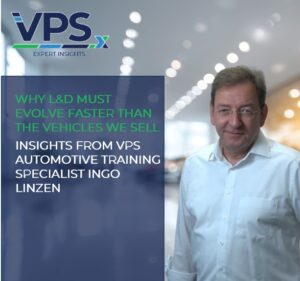
Ingo W. Linzen is an Automotive Training Specialist and Account Manager for automotive clients at VPS EMEA, a global leader in learning solutions. With over 20 years at VPS and a career spanning nearly four decades, Ingo is a true all-rounder across the entire training value chain, from strategy and governance to delivery and innovation. He serves as the primary point of contact for one of our largest automotive clients, building long-term partnerships and driving modern learning approaches for automotive retail networks. His background includes international management roles, a degree in business administration, deep experience with OEM training programmes, and a strong focus on simulation, digital learning, and capability development.