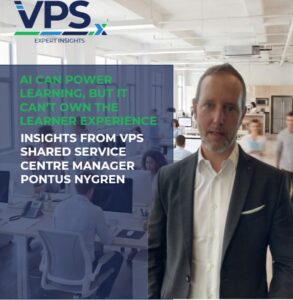
AI can power learning, but it can't own the learner experience
Many organisations are increasing their reliance on agentic AI for learning operations, and the opportunity is clear. Jeff Bezos recently compared AI to giving employees a bulldozer instead of leaving them to dig out a basement with a shovel: a powerful image of how AI can transform productivity when applied to repetitive, labour-intensive work. In training administration, AI can reduce effort, accelerate predictable workflows and free people from avoidable manual activity.
However, the strongest case for AI is not that it replaces people, but that it gives skilled people better tools. Sam Altman has made a similar point from the opposite direction. Reflecting on his own use of AI to manage emails and Slack messages, he said: “We really do care about our interactions with people,” adding that personal communication is “not something that I can imagine myself outsourcing to an AI anytime soon.” His point is especially relevant to learning operations, where service quality depends not only on speed, but on judgment, context, empathy and trust.
VPS provides a model that combines automation with trained administrators who handle complex requirements and support learners across languages, sectors and markets. AI creates efficiency in structured processes, but training administration also includes decisions that depend on context, discretion and human communication. With more than 20 years delivering managed learning services, multilingual service centres, award recognition and proven governance practices, VPS provides reliability and quality that AI alone cannot match. VPS offers a cost-efficient operational model that protects service quality while avoiding the hidden expenses that pure automation can create.
AI Creates Efficiency, but Training Administration Requires More Than Efficiency
AI has become an established component of modern learning ecosystems. VPS integrates AI into scheduling, ticket routing, logistics support and conversational interfaces that answer common knowledge-based queries such as “how to” and “where do I find this”. AI improves throughput for predictable tasks, reduces bottlenecks and supports time sensitive workflows.
However, training administration involves operational decisions that are not predictable. Even well-structured programs generate exceptions, stakeholder changes, last minute resource movements, regulatory questions and learner uncertainties. These moments require interpretation, context and discretion. AI operates within defined rules, but it cannot understand the organisational or political implications behind a request, nor can it assess the risk of deviating from standard procedure.
VPS has spent more than 20 years providing managed learning operations across multiple industries, with global hubs working in coordinated governance models. This history demonstrates that AI supports the work but does not replace it.
The Demand for Human Judgment in Training Operations
Training administration is heavily reliant on operational judgment. VPS service centres support large volumes of training activities at scale, and each centre uses workflow management systems, Six Sigma methodologies and structured review processes to manage tasks from catalogue creation to session closure.
Human involvement is required because many tasks involve decisions where context matters. Examples include:
- Re‑planning sessions when instructors or facilities become unavailable.
- Determining acceptable alternatives when a learner faces compliance deadlines.
- Reviewing catalogue inputs for accuracy before an LMS update takes place.
- Coordinating multi‑market changes when a client adjusts business rules.
- Validating logistics exceptions when automated allocation does not match situational needs.
VPS advisors intervene to prevent cascading errors that automated systems alone may not recognise. Human supervision identifies subtleties such as cross‑market sensitivities, cultural expectations and operational risks, which require experience rather than algorithmic matching.
This model has been reinforced through VPS’s long-standing service transitions, achieved without disruption to client operations and with all milestones met, even in complex, multi‑country training environments.
Learner Experience Requires Human Interaction
VPS operates multilingual, multi‑channel learner care through its service centres. The Barcelona centre alone supports customers in 12 European languages with staff from 15 countries. AI-driven conversational chat handles simple queries, but learners often contact support with incomplete information, emotional concerns or urgent issues.
Human advisors provide clarity, confirm assumptions and communicate in a way that reflects cultural and linguistic nuance. This is particularly important for regulated sectors where precision matters and where learners require reassurance that their training progress is properly tracked.
VPS supports learners through enrolment, attendance issues, LMS navigation and post‑course assistance. When needed, advisors interpret policy, mediate between stakeholders and intervene where business rules require judgment rather than automation. AI cannot replicate this relational and interpretive capability.
Why the VPS Service Centre Model Works Better Than AI‑Only Approaches
VPS provides a structured, award‑winning service centre model that integrates automation with human capability. Each service centre has been recognised for operational effectiveness and governance performance across learning administration and logistics and is designed to scale across industries.
Three characteristics make this model more reliable than an AI‑only approach.
1. Human‑validated automation
The VPS workflow management system automates catalogue creation, session planning, logistics routing, resource allocation and financial routing. Advisors review each stage for accuracy and viability. This prevents operational failures that occur when automation makes high‑confidence but context‑blind decisions. Examples include schedule conflicts, facility errors or participant misallocation, which VPS teams routinely correct before they impact learners.
2. Multilingual, culturally aware support
Training administration requires clear communication across borders. VPS service centres have multilingual and culturally diverse teams who communicate effectively with learners and client stakeholders. These teams provide support that AI translation tools cannot consistently match, particularly when handling sensitive or time‑critical issues. VPS maintains local offices across the UK, Germany, Spain, France, Sweden and Ireland, giving clients access to advisors who understand local context and industry practices.
3. Context‑driven escalation and governance
VPS advisors use operational context to determine when to escalate issues. Governance is driven by experienced project managers who work with clients on KPIs, data insights and process improvements. AI contributes to data consolidation, but VPS teams interpret insights, identify root causes and adjust processes with agility. VPS’s governance model has been central to its reliable program delivery record for over 20 years.
Cost Arguments: Why VPS’s Hybrid Model Is More Economical Than AI‑Only Approaches
AI-only operating models appear cost‑efficient because they reduce headcount on paper. In practice, they create new costs:
- Error correction costs when automated processes misclassify tasks or schedule incorrect sessions.
- Escalation bottlenecks when AI cannot interpret nuance, causing delays and additional support tickets.
- Reputational and compliance costs when mistakes impact regulated training or certification.
- Hidden vendor costs from maintaining AI models, troubleshooting system logic, and managing reconfiguration cycles.
VPS reduces these hidden costs by combining automation with experienced administrators who correct risks early. VPS’s operational history shows that human-led verification avoids rework, stabilises planning and reduces errors in logistics, approvals and learner interactions. This hybrid model supports efficiency without compromising quality.
VPS’s workflow automation reduces effort, and VPS advisors provide flexibility that prevents costly disruptions. This is reinforced by structured financial oversight in service centres, where planning dashboards and budget reviews help keep training operations within agreed spend levels.
Governance Frameworks: How VPS Maintains Control, Transparency and Accountability
VPS provides governance frameworks that support operational clarity:
- Monthly governance meetings supported by centralised data dashboards that show volume trends, resource utilisation and budget status.
- KPI structures that connect operational activity to business results and track learner experience outcomes.
- Annual governance cycles that review discrete and recurring metrics, preparing organisations for the next year’s requirements.
- Continuous improvement frameworks using Six Sigma, Agile and Lean methodologies to optimise workflows and reduce friction points.
AI contributes to data consolidation, but human teams interpret the signals, prioritise risks and adjust processes.
Operational Models: How VPS Delivers Large‑Scale, Stable Learning Administration
VPS operates multiple service centres that provide:
- Centralised administration, supported by Barcelona and offshore teams, for high‑volume, multilingual operations.
- Distributed local support, with teams in Germany, the UK, France, Sweden and Ireland, enabling sector‑specific expertise and onsite alignment.
- Scalable staffing models, where resources expand during peak demand and contract when volumes stabilise, based on data patterns and ticket trends.
- Workflow management systems that provide transparency into planning, scheduling and logistics, reducing unnecessary manual activity while keeping accuracy high.
This operational model has delivered 20+ years of successful learning services across industries, supported by award recognition for learning programmes, innovation and service quality.
AI Enhances Human Administrators, It Does Not Replace Them
VPS uses AI to handle routine tasks in scheduling, ticket routing, knowledge retrieval and data processing. These tools reduce friction and allow human agents to focus on judgment‑based work. VPS’s long-term strategy positions AI as a support layer, not a replacement. Human administrators carry responsibility for decisions, exceptions, stakeholder management and learner communication.
This hybrid model provides reliability, adaptability and service quality. AI-only approaches introduce risk when they misinterpret context, misclassify requests or apply rules without discretion. VPS avoids these risks by maintaining a human-led model that incorporates AI to increase efficiency.
Summary
VPS provides a training administration model that uses automation for efficiency and trained administrators for judgment, communication and operational stability. VPS operates multilingual service centres that manage catalogue creation, scheduling, logistics, learner support and reporting using workflow systems and Six Sigma practices, which reduces errors and improves reliability. The service centres support markets in 12 languages and apply culturally aware communication that AI alone cannot deliver. VPS also applies governance frameworks that include monthly reviews, KPI‑driven decision making and continuous improvement cycles, which connect daily operations to business outcomes and long-term planning.
AI contributes by handling routine tasks and simple learner queries, but human intervention remains essential for exceptions, compliance considerations and learner needs that require interpretation or reassurance. VPS uses a hybrid model because the cost of correcting automation errors, addressing missed escalations or repairing learner trust often outweighs the savings of AI‑only approaches. VPS’s operational model, supported by workflow transparency and structured oversight, helps organisations avoid these hidden costs while maintaining predictable performance across regions.
With more than 20 years delivering managed learning services, including award‑recognised service centre operations, VPS continues to provide stable, scalable and cost‑efficient training administration that balances automation with human expertise. This combination protects service quality, supports learners and provides operational control that AI‑only models cannot match.
Contact us today to build a learning experience that uses the latest AI toolset while maintaining a human touch.